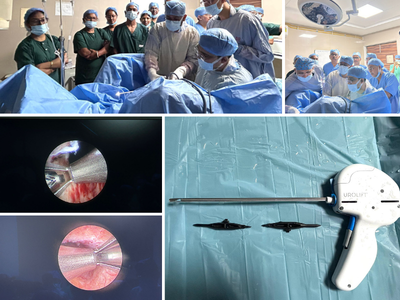
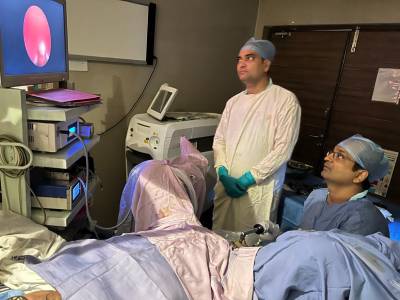
RG Rajouri Garden : Successful Management Of A Very Large Prostate (~288 cc) Using Mini-HOLEP (MiLEP)
This is a sensitive image.
Click here if you wish to view it.
Faculty:
Dr. Kapil Jain – Sr. Consultant, Urology
Presenting/Chief Complaints:
A 77-year-old male presented with complaints of obstructive voiding symptoms and recurrent episodes of urinary retention. The patient had a history of non-compliance with previously prescribed medical management.
Clinical Findings:
- Ultrasonography revealed chronic cystitis with a grossly enlarged prostate (~288 cc) and a prominent median lobe bulge.*
- Serum PSA: 19.62 ng/ml
- Multiparametric MRI prostate: PIRADS 3 lesion
- TRUS-guided prostate biopsy: Benign Prostatic Hyperplasia (BPH) with chronic prostatitis
Pre-operative Assessment:
The patient was evaluated and deemed fit for surgery. Comorbidities included hypothyroidism and arthritis, both well-controlled on medication. Pre-anaesthetic evaluation was unremarkable.
Procedure:
- The patient was counselled and planned for Mini-HOLEP (MiLEP).
- Intraoperative findings included a normal urethra, massively enlarged prostate, and a trabeculated bladder.*
- Using a 22 Fr endoscope and Holmium Laser complete enucleation of the prostatic adenoma was performed.
- Special attention was given to precise dissection at the apical region.
- Total laser time: ~70 minutes
- Blood loss: Minimal
- The procedure was completed uneventfully.
Post-operative Course:
- The patient had a stable recovery.
- The catheter was removed on post-operative day 2.
- The patient was discharged the same day, with a total hospital stay of 2 days.
On follow-up:
- Good urinary flow
- No urinary incontinence
- Post-void residual urine: 90 ml
Histopathology:
BPH with chronic prostatitis.
Key Highlights:
- Successful management of a very large prostate (~288 cc) using Mini-HOLEP, demonstrating the effectiveness of laser enucleation even in complex, high-volume cases.
- Dr. Kapil Jain’s surgical expertise enabled precise enucleation, particularly at the apical region, ensuring complete adenoma removal with preservation of continence.
- The procedure was performed with minimal blood loss and optimal operative time, reflecting advanced endoscopic skill and control.
- Patient benefited from rapid recovery, early catheter removal, and short hospital stay, with excellent functional outcomes.
- Highlights the advantage of modern small-calibre endoscopic techniques in reducing morbidity and improving overall patient comfort in large gland surgeries.
Categories
This is a sensitive image.
Click here if you wish to view it.
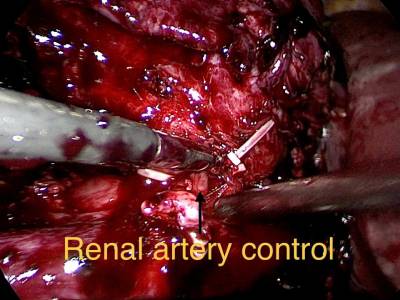
RG Kolkata: Management of Nonfunctioning Kidney Secondary to Staghorn Calculus - With IVC Plastered and Frozen Hilum
This is a sensitive image.
Click here if you wish to view it.
RG Rajouri Garden : Successful Management Of A Very Large Prostate (~288 cc) Using Mini-HOLEP (MiLEP)
This is a sensitive image.
Click here if you wish to view it.
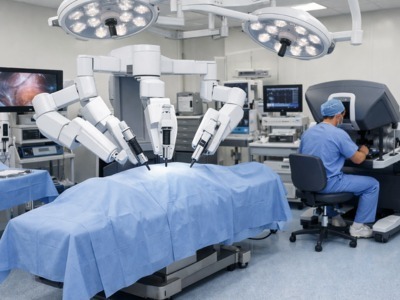
RG Rajouri Garden : Successful Robotic Radical Prostatectomy in a Prostate Cancer Case